For New York City restaurant operators, protecting profit margins is a relentless battle. Raising prices risks alienating loyal guests, while trimming portion sizes can instantly damage your hard-earned reputation.
Fortunately, you don’t have to make those painful compromises. The solution lies in menu engineering—a disciplined, data-driven process that analyzes your menu to pinpoint which items in every category (appetizers, salads, entrées, and desserts) deliver the strongest margins. Instead of broad, reactive guesswork, it allows you to make precise, highly profitable adjustments.
What Are Menu Metrics?
Menu metrics are the key performance indicators that show how each menu item is truly performing — not just how often it sells, but whether it’s contributing to your restaurant’s profitability.
Important menu metrics include food cost percentage, contribution margin, sales mix, theoretical versus actual food cost, and portion variance. Together, these measurements provide a clear view of which menu items are driving profits and which may be quietly reducing margins.
For restaurants managing large menus or multiple locations, tracking these metrics is essential for maintaining operational consistency. They help identify issues such as portion control inconsistencies, rising ingredient costs, and menu items that may require pricing adjustments. Accurate recipe costing is the foundation that makes reliable menu analysis possible.
Popularity Isn’t Profitability
Most operators know their top-line sales cold. What they often miss is which dishes are actually driving profit—and which ones are quietly eroding it.
Every item on your menu should earn its place based on two metrics: popularity (how often guests order it) and profitability (how much margin it generates when they do). Menu engineering connects those two data points into something actionable.
Four Levers That Move the Needle
1. Focus on contribution margin, not food cost percentage. Contribution margin (selling price minus food cost) tells you how many real dollars each dish puts in your pocket. A high food cost % on a $45 entrée may still outperform a low food cost % on a $12 app.
2. Classify every item. Sort your menu into four categories:
- Stars—high popularity, high margin. Protect and promote these.
- Opportunities—high margin, low popularity. Reposition or market harder.
- Puzzles—popular but low margin. Adjust pricing or portion size.
- Duds—low on both. Cut them or rework the recipe.
3. Use anchor pricing. Lead each section with your most expensive item. Guests won’t always order it—but it makes everything beneath it look like great value, naturally steering them toward your high-margin dishes.
4. Automate your data. While some operators still manage this manually via spreadsheets, modern restaurant management platforms (like Restaurant365) completely automate the process. By integrating your Point-of-Sale (POS) sales data with live vendor pricing and ingredient databases, these systems calculate real-time recipe costs and profitability even as market prices fluctuate.
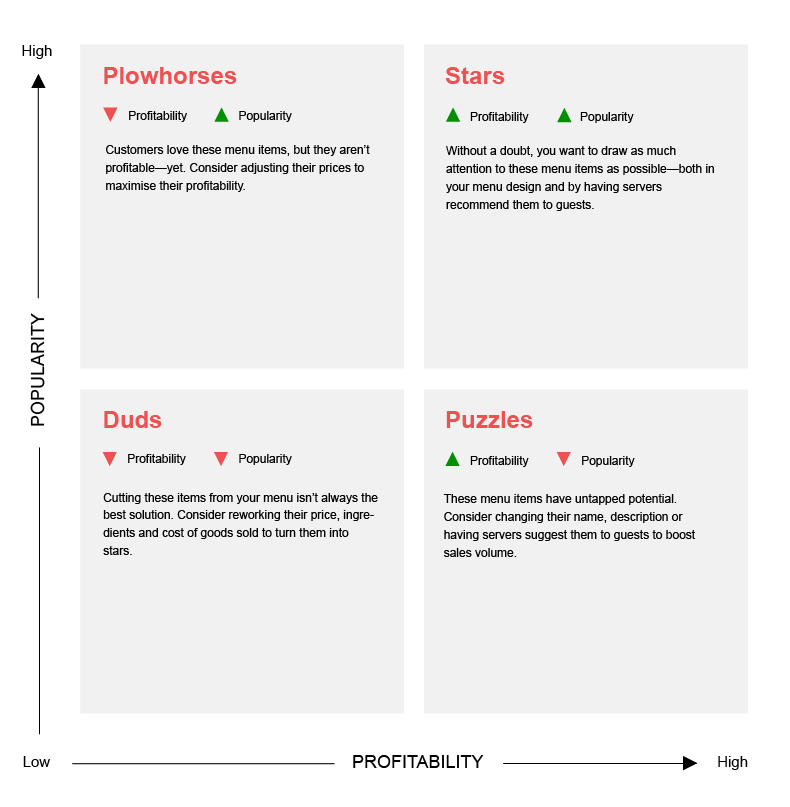
The Menu Engineering Matrix: Item Categorization
To turn your menu into a performance tool, items are analyzed and grouped into four distinct operational categories:
Design Is Strategy
How your menu looks is just as important as what’s on it.
- Eye movement matters. On a two-panel menu, the eye lands center-right first, then top-left, then bottom-right. Put your Stars there.
- Box your best items. A simple shaded border draws the eye and signals importance.
- Drop the dollar sign. Writing 14 instead of $14.00 measurably reduces the psychological sting of spending.
- Don’t stack prices in a column. A right-aligned price list turns your menu into a spreadsheet. Nest prices at the end of descriptions instead.
- Limit section length to ~7 items. Too many choices cause decision paralysis—and indecision doesn’t spend money.
” A menu isn’t just a list; it’s a strategy. Done right, it guides customer behavior, highlights your best work, and scales your profitability far more effectively than a blanket price hike.”
— William Lee, founder of Bookkeeping Chef
Measure Your New Menu’s Impact
After your redesign has been live for about a month, pull your sales data and look for real movement. Are your Stars and Opportunities selling more? Did overall profit increase? Did food costs come down?
Use what you find to keep iterating—adjust dishes, test new additions, and refine your layout. A menu is never truly finished. Track every change so you know what’s working and what isn’t.
This Isn’t a One-Time Project
Menu engineering works because it’s ongoing. Revisit your matrix quarterly, rotate seasonal ingredients to capitalize on lower wholesale prices, and keep consulting your front-of-house team—they hear guest reactions that no spreadsheet ever will.
Done consistently, menu engineering can increase revenue by up to 35% without raising prices or shrinking portions. Your menu is already in guests’ hands every service. Make it work harder. For more information on this topic, or to learn how Bookkeeping Chef’s restaurant specialists can help optimize your operations, contact our team today for a free consultation.